






Cresta Palace: how a grand hotel replaced fourteen tools with one platform
Five outlets, a spa, website, newsletter, social media: how Cresta Palace now runs everything in two Jamatu suites instead of 14 tools.
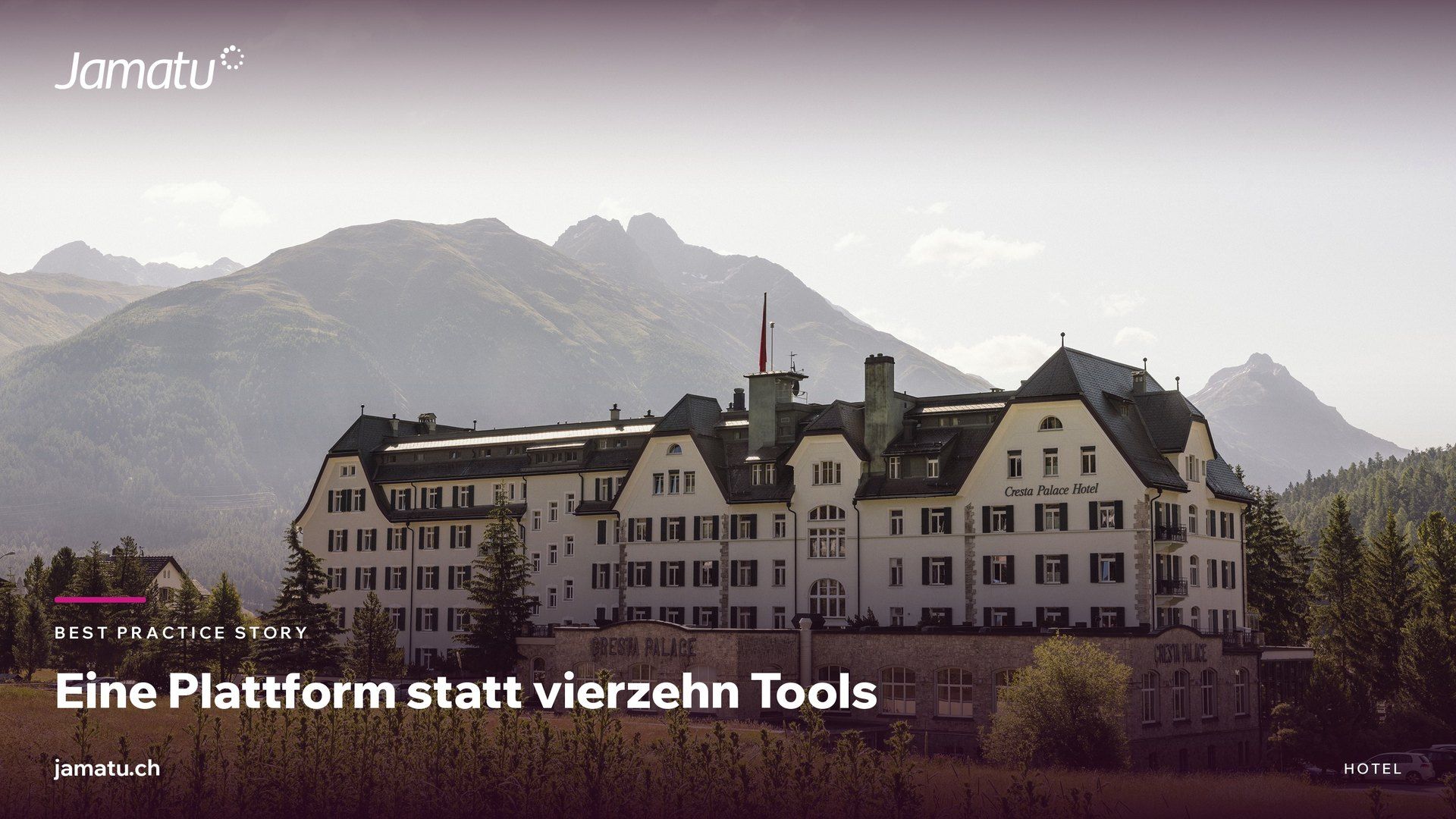
Celerina, two kilometres from St. Moritz. At the Cresta Palace, five restaurants and bars, a spa with more than sixty treatments, banquets, a shop and a website in three languages meet a team that wants to look after guests, not software. A year ago that team needed fourteen different programs to get through an ordinary day. Today it needs two: the Jamatu Hospitality Suite for the operation and the Jamatu Business Suite for the company. This is the story of that rebuild.
Fourteen tools, fourteen invoices, no overview
The starting point in spring 2026 looked like it does in many hotels of this size. Over the years, every department had found its own tool. Each one was reasonable on its own, and together they formed a web that nobody could fully see any more.
| Task | Tool before Jamatu |
|---|---|
| Point of sale in five outlets | Lightspeed, six separately licensed outlets |
| Card payments | Nexi, four rented payment terminals |
| Table reservations in four restaurants | Aleno |
| Spa bookings | TAC Informationstechnologie |
| Online room bookings | OnePageBooking, with interfaces to Trivago, Google and Nexi |
| Gift vouchers | e-guma |
| Newsletter | dailypoint |
| Website | Wix through an agency, maintenance on request |
| SEO and search ads | Online Birds, an agency with its own licence |
| Google Ads | Google Ads, managed separately |
| Meta Ads | Meta Ads, managed separately |
| Social media | Facebook and Instagram, maintained by hand |
| Internal reports | Slack, 18 users |
| Ordering devices for service | OrderCube, already quoted, not yet in use |
On their own, the running costs of this toolbox added up to a considerable sum every year, before any advertising budget. But the work between the systems cost more than the money. The menu was maintained in the till and copied to the website by hand. A guest who had booked in the spa, reserved at the Grand Restaurant and paid at the bar existed three times in three databases and nowhere as one person. Reporting meant pulling exports from six programs into one spreadsheet. And there was simply no foundation for automation or AI, because none of the systems talked to each other.
The decision: do not replace tool by tool
The obvious solution would have been to cancel the most expensive contracts one at a time. The Cresta Palace chose a different path. Together with Jamatu, the existing system landscape was first recorded with every contract, term and notice period, and then an overall solution was planned. The principle behind it: a hotel is one company with several points of sale. What belongs to a single point of sale, the till, the kitchen, the tables, the orders, lives in the Hospitality Suite. What belongs to the whole house, guests, bookings, website, marketing, figures, lives in the Business Suite. The two share guest data and figures, but each does only what it does best.
The rollout took eight weeks: four weeks of remote preparation, three weeks on site in Celerina with installation and training for service, kitchen, reception and marketing, then the go-live in May 2026 with a week of support.
In the operation today: the Hospitality Suite
In all five outlets, the Grand Restaurant, Giacomo’s, Asia 75, the Chäs Beizli with its garden and the bar, JamWaiter now runs as the point of sale. One subscription for the whole house instead of six licences, on the tablets and smartphones the team already had. Payments are taken on the JamTerminal with its own SIM, so card margin and terminal come from one source, and the Nexi devices have been returned.
For the rooms the hotel set up 25 QR codes in JamOrder’s hotel service mode. A guest scans the code on the bedside table, sees the room service menu in their own language and orders. The order lands in the kitchen without a phone call and without a slip of paper. Twenty JamButtons in the restaurants and on the terrace call service to a smartwatch as soon as a guest needs something.
This also covers the things that used to need separate programs. Table reservations are built into the till: a reservation becomes an open table and, at the end, a bill. Vouchers are sold online and redeemed at any till, with balance and history visible at all times. The cash book records every deposit and withdrawal. And Jonida, the AI assistant in JamWaiter and OrderAdmin, answers the team’s questions about how things work, reports yesterday’s revenue or marks a dish as sold out on request.
In the company today: the Business Suite
Above all of this sits the Business Suite. Here the Cresta Palace is one organisation with one brand and six locations: the spa and the five food and beverage outlets. Whoever signs in first sees the overview of the whole house and can switch to a single location with one click.
Spa bookings. The more than sixty treatments in seven categories, from signature treatments to Pilates and yoga, are managed with duration, therapist, room and price. Guests book online on the hotel’s website, and availability is always right because there is only one calendar left. At the start of the season the winter menu is switched on and the summer menu switched off, in three languages, without anyone opening a second piece of software.
Contacts. The guest who used to exist three times is now one person: with their spa appointments, their reservations, their newsletter consent and their vouchers. Visits from the outlets flow into the profile, and the profile is available at every till.
Website and newsletter. The hotel’s website in three languages is maintained from within the Business Suite. Menus come straight from the till, so a price change in the Grand Restaurant is online the same evening. The newsletter goes to the contacts in the same database, with clean consent and no export file.
Marketing plan and social media. Posts for Facebook and Instagram, campaigns on Google and Meta and the newsletter dates all sit in one plan. The marketing team sees the week at a glance, approves posts and publishes them from the suite. Listings, reviews and visibility on the map run in the same tool.
Reporting. The figures from all outlets and the spa come together automatically. Management sees revenue, reservations, orders and open invoices per location or for the whole house, without building a single spreadsheet.
A day at the Cresta Palace
At seven in the morning a guest from Milan books a massage for the afternoon on the Italian website. The appointment appears in the spa’s calendar, the guest in the hotel’s contact book. At half past twelve a couple scans the QR code in their room and orders two salads and a bottle of water. The kitchen prints the ticket and room service brings the tray. At six the same family reserves a table at Giacomo’s through the website. The reservation is in JamWaiter, the table is opened at eight and charged to the room at ten. In between, a guest on the terrace presses the JamButton and the service team’s smartwatch vibrates. In the afternoon, marketing plans the Instagram post about the new winter menu in the spa and approves Friday’s newsletter. And at eleven at night the director sees on the overview what the house did today, outlet by outlet.
None of it needs a second program, an export file or a phone call between two departments.
What changed in numbers
| Before Jamatu | Today | |
|---|---|---|
| Programs in use | 14 | 2 Jamatu suites, plus the hotel’s property system for the rooms |
| POS licences | 6 licences | 1 subscription for the whole house, 95 percent cheaper |
| Spa booking tool | own licence | gone, included in the Bookings module |
| Payment terminals | 4 rented devices | JamTerminals without rental |
| Running costs per year, excluding ad budget | 100 percent | 74 percent, including SEO, listings, campaigns and hosting |
| Guest databases | 3 | 1 |
| Menu on the website | updated by hand | automatically from the till |
Around a quarter less in running costs per year, calculated conservatively and without counting the hours that used to disappear between the systems. The bigger gain is not in the table: for the first time, the Cresta Palace has one shared data basis for guests, revenue and marketing. On that, things can be built that were impossible with fourteen isolated solutions, from the automatic message after a spa visit to the AI that answers the team’s questions.
«With Jamatu we have perfectly combined digital efficiency and personal luxury, a win for guests and staff!»
Bardhyl Coli, Director, Cresta Palace
What this means for other hotels
The Cresta Palace is not a special case. Almost every hotel with several outlets and a spa carries the same toolbox around, pays for it per point of sale and holds it together with manual work. The way out is not to buy the next tool. It starts with a list of every contract and the question of what belongs to the point of sale and what belongs to the house.
Do you run a hotel or a business with several outlets and want to know what your list looks like? We will record your system landscape with you and show you what one platform makes of it. Get in touch.